Revisit the question that started the work
A development investigation can produce interesting observations without resolving the question that justified it. The review begins by restating the original decision, the agreed requirements, and the investigation boundary. If the question changed during the work, that change needs to be visible.
Findings can then be connected to specific questions rather than presented as an unstructured collection. This helps a client distinguish a relevant result from a useful but separate discovery. It also makes unanswered questions easier to identify.
Keep observations, interpretations, and recommendations distinct
An observation describes what was recorded. An interpretation explains what the team thinks it means. A recommendation proposes what to do next. Combining these into a single confident sentence can make a weak conclusion difficult to examine.
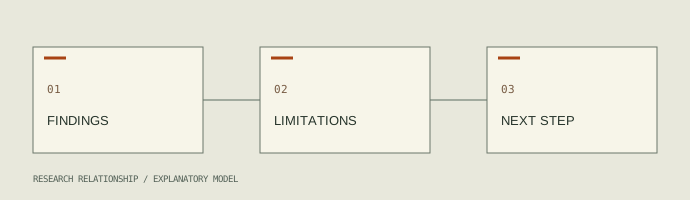
A review package separates these layers and records significant qualifications. It identifies missing information, deviations from the plan, and dependencies on assumptions. Where different findings point in different directions, the package should preserve that disagreement rather than smoothing it into a reassuring summary.
Choose an appropriate next commitment
Possible next steps include another focused experiment, a revised prototype, a specialist assessment, a broader development phase, or stopping the concept. The recommendation should explain why that commitment is appropriate to the evidence and the consequences of being wrong.
Open actions need an owner and a defined purpose. A long list of “further research” is not enough. The review should identify which item affects the immediate decision and which can reasonably wait. Commercial and operational judgments remain part of the client’s decision, even when the technical findings are encouraging.
Leave a record another team can understand
The output can contain a concise decision summary, an evidence register, limitations, unresolved actions, and a record of the chosen direction. References should point to the relevant version of a brief, prototype description, or observation record.
The record should state what was decided, by whom, and what would trigger a review. It does not need to pretend the uncertainty has disappeared. A well-defined reason to revisit a decision can be more useful to a future team than a claim that the issue was permanently settled.