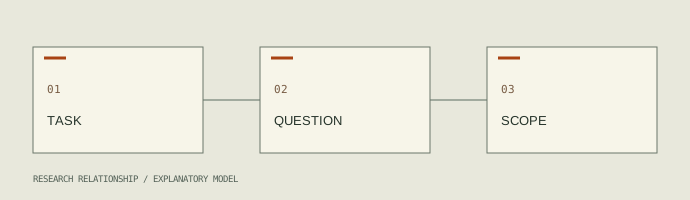
Start with the decision, rather than a preferred solution
An initial conversation may begin with “we need a sensor” or “we should automate this step.” A research brief asks what the organization needs to decide and why. The underlying problem may involve missed observations, inconsistent information, awkward handling, or a task that takes too much attention.
The brief separates the problem from the proposed answer. It records the current situation, the users involved, the effect of the problem, and what would count as a useful improvement. A solution preference can remain in the brief, but it should be identifiable as a preference rather than an established requirement.
Make constraints usable
A requirement such as “easy to use” needs context. Who uses the equipment, under what conditions, and while doing which other tasks? A cost limit needs to state whether it refers to a prototype, a purchased component, or an eventual production unit. An installation constraint may matter more than a feature list.
The brief can organize these conditions into required, preferred, and unresolved items. Each important condition needs an owner who can explain or confirm it. Where information is missing, the brief records the gap instead of filling it with an unsupported number.
Connect questions to the next activity
Not every uncertainty calls for an experiment. Existing documentation may settle a compatibility question. A conversation with intended users may clarify a handling problem. A small feasibility study may be appropriate when several technical routes are plausible.
The proposed work should identify which questions it will address, the kind of evidence needed, and the limits of that evidence. This keeps a short investigation from quietly becoming an unlimited development commitment. Questions outside the immediate scope remain visible for later work.
What the client can take forward
The output is a written research brief with a problem statement, decision context, requirements, constraints, assumptions, and recommended investigation scope. A review discussion checks that the document reflects the client’s situation and distinguishes agreed facts from information that still needs confirmation.
The brief can support an internal planning meeting or a request to a development specialist. It is not a quotation from a manufacturer or a guarantee that a concept will succeed. Those commitments need their own assessment after the relevant evidence has been collected.